

For Individuals & Caregivers
The Death with Dignity Act
Medical Aid in Dying is an option that allows terminally ill individuals — who meet the specific qualifications of Oregon’s Death with Dignity Act — to end their lives through voluntary, self-administration of life-ending medication that is prescribed by a participating physician for the purpose of ending one’s life.
Medical Aid In Dying is an individual-centered process that provides autonomy and dignity over the dying process, reduces unnecessary suffering, and provides peace of mind. The Death with Dignity Act ensures Medical Aid In Dying meets legal and ethical requirements.

Considering Death With Dignity? We Encourage you to Connect with our Team as Soon as Possible
If you are interested in utilizing the Death with Dignity Act and meet the requirement please contact us as soon as possible. Delaying the qualification process can cause an inability to meet the law’s requirements.
Eligibility
To be eligible to use Oregon’s Death with Dignity Act, you must:
Be 18 years or older
Have a documented terminal illness with a life expectancy of 6 months or less.
Be physically present in Oregon
If you reside out of state, you must complete the qualifying process and take the life-ending medication in Oregon. If you do not wish to have your planned death right after you qualify, your participating physicians may allow you to travel back to your home state and then return for your planned death. However, this is completely up to the discretion of your participating physicians, some who do not allow their patients to leave the state once they begin the qualifying process.
Be capable of making and communicating your own healthcare decisions.
Be capable of self-administering the life-ending medication.
Two licensed, Oregon physicians must determine that you meet all of the eligibility requirements to use the law. One physician is your Attending Physician, who oversees the qualifying process and writes your prescription. The other physician is the Consulting Physician, who gives the second determination of eligibility. Participating physicians can only be Medical Doctors (MD) or Doctors of Osteopathic Medicine (DO).
If I’m eligible for hospice, do I qualify for the Death with Dignity Act?
Eligibility for hospice does not always equate to eligibility for the Death with Dignity Act. Only your two qualifying physicians can determine if you meet the requirements for the law.
What if I am not eligible? Do I have other options?
If you are facing end-of-life but do not meet Oregon’s criteria for the Death with Dignity Act, speak with your healthcare team or our volunteers to learn about your other end-of-life options. These include hospice, stopping or declining life prolonging treatment, and Voluntarily Stopping Eating and Drinking (VSED). You can contact us to learn more.
Finding a Qualifying Physician
Ask any of the MDs or DOs on your healthcare team to be your qualifying physician. It is always recommended that first and foremost you ask your own healthcare provider(s) to be your qualifying physicians.
Your own providers will be able to make the best determination as to whether you legally qualify for the Death with Dignity Act.
In general, it saves time. You don’t have to have records transferred or wait for additional evaluations.
If your physician(s) can not or will not participate as a qualifying physician, ask them if they can refer you to a physician(s) that can.
If only one of your physicians will qualify you, ask them if they have a referral for the other physician needed by the law. Many physicians who have been qualifying physicians before have a network of other physicians that they have worked with for the qualifying process.
If you have talked to your physicians and cannot find the 2 qualifying physicians required by the law and they do not have referrals, contact EOLCOR so we can help.
If your physicians would like to participate, but are new to the process and need some guidance, advise them to reach out directly to EOLCOR, where we have experienced physicians who can mentor them throughout the process.

How Do I Talk With My Physician About Using the Death With Dignity Act?
Many individuals feel anxious about talking to their physicians about Medical Aid In Dying, but it is important to discuss your wishes early in your illness. The law requires you to make direct oral requests to a licensed, Oregon MD or DO, no one can do this on your behalf, nor can it be done through an Advanced Directive.
Here are suggestions for discussing this option with your physicians:
“I would like to have the option to use Oregon’s Death with Dignity Act if my suffering becomes unbearable. Am I eligible?”
If yes:
“Will you be either the Prescribing Physician or the Consulting Physician required by Oregon law?”
“Will you document in my medical record that I asked to use DWD and that I’m eligible?”
If a physician refuses participation:
“Will you document in my medical record that I asked to use DWD and that I’m eligible?”
“Will you refer me to physicians who will participate as a Prescribing and Consulting physician?”
If you are not eligible at this time:
“When I become eligible, I would like to have DWD as an end-of-life option.”
“Do you have a timeframe as to when I can meet eligibility?”
“At that time, would you agree to be either the Attending or Consulting physician?”

The Death With Dignity Qualifying Timeline
The Death with Dignity Act requires a minimum 15-day qualifying timeline, however, realistically qualifying could take longer due to record transfers and participating physician availability. During the qualifying timeline, you must make 3 formal requests to your qualifying physicians to use the Death with Dignity Act . Two of these requests are verbal, separated by a minimum of 15 days, and one is written. Requests can be rescinded at any time. You must also have an evaluation from each of your Oregon, participating physicians and complete a mental health evaluation by a licensed, Oregon psychologist or psychiatrist if required by your participating physicians.
For many individuals and caregivers, this period can feel emotional and uncertain, leading to meaningful discussions and planning. Trained EOLCOR volunteers are here to help, they are available to help guide and support you, answer questions, and ensure that each part of the process is as clear and manageable as possible. Contact our team for help.
Death with Dignity Act Qualifying Time
This qualifying timeline lets you know what to expect and when required steps should occur. The qualifying process begins when you make a first oral request to a licensed, Oregon physician. The days that follow include time for reflection, additional conversations, medical evaluations, and completing required forms.
1. Make Your 1st Oral Request
Begins the 15-day qualifying period, starting day 0 of 15.
Must be a direct, verbal request for life-ending medication, not a general or informative discussion about the Death with Dignity Act or Medical Aid In Dying.
Must be made directly to a licensed, Oregon MD or DO, not office staff. Can be made to any physician without limitation, including your primary care provider or specialist, provided the Attending Physician accepts it as valid.
For the Attending Physician to accept the request as valid they must make the determination that the physician who took the First Request fully informed you of all items statutorily required to take the first request.
The physician taking the request must document the request in your medical chart.
2. The 15-day Qualifying Period
Patient
Has medical records transferred to Consulting and Attending Physician.
Has evaluations with the Consulting and Attending Physicians.
Completes the state-mandated Request for Medication to End My Life in a Humane and Dignified Manner form and submits it to the Attending Physician.
Can be submitted in person or mailed. If mailed, confirm receipt from the Attending Physician.
The form must be submitted 48 hours before the life-ending prescription can be issued, if possible, submit at least 48-hours before the 2nd oral request, so the prescription can be written the day of the 2nd oral request.
Keep a copy of the form for your records.
Form Requirements
Requires 2 witnesses who observe you signing the form and attest to your mental clarity and lack of undue influence. All parties must sign the form at the same time.
Only 1 witness may be entitled to any portion of your estate upon your death.
Only 1 witness may own, operate, or be employed at a healthcare facility where you are a patient or reside.
Participating physicians and EOLCOR volunteers cannot witness your signature.
Attending Physician
Evaluates for eligibility.
Counsels about the life-ending medication and the planned death. Collects Consulting Physician Form and Request for Medication to End My Life in a Humane and Dignified Manner form.
Consulting Physician
Evaluates for eligibility and submits the Consulting Physician Form to the Attending Physician.
Mental Health Evaluation
If either qualifying physician questions your judgement or ability to make your own healthcare decisions, they must refer you to a licensed, Oregon psychologist or psychiatrist for a mental health evaluation. To qualify for the law, the mental health provider must determine that you can make decisions, have intact judgment, and do not have a mental health disorder or depression causing impaired judgement.
3. Make Your 2nd Oral Request to Your Attending Physician
Must be made after the mandatory 15-day qualifying period.
At the discretion of the Attending Physician, may be made by phone or teleconference.
Attending Physician:
After the second oral request and the required 48-hour waiting period from the date on the Request for Medication to End My Life in a Humane and Dignified Manner Form, the prescription can be written.
Must mail or hand deliver the life-ending prescription to the pharmacy.
Submits all of the legally, required, confidential documentation to Oregon Health Authority.
4. The Prescription
Can be filled immediately or left at the pharmacy until requested.
Expires after six months.
Must be ordered in advance and is usually available within 2-3 days.
Your Attending Physician will ensure the prescription is sent to a participating pharmacy.
Prices vary, contact your insurance provider for information regarding coverage.
Can be picked up by an authorized individual designated by the patient, who must show ID.
In some areas, courier delivery may be available.
Note: EOLCOR volunteers cannot pick up prescriptions for clients.
5: Final Steps
Once you receive the life-ending prescription, you can decide if and when you would like to have your Planned Death.
For your records, be sure to retain:
Name of Prescribing Physician
Name of Consulting Physician
Date of 1st verbal request
Date of 2nd verbal request
Copy of Request for Medication to End My Life in A Humane and Dignified Manner form
-

Client Forms for DWDA
All forms required by clients when using the Death With Dignity Act. See our DWD overview page to learn more about DWDA.
-
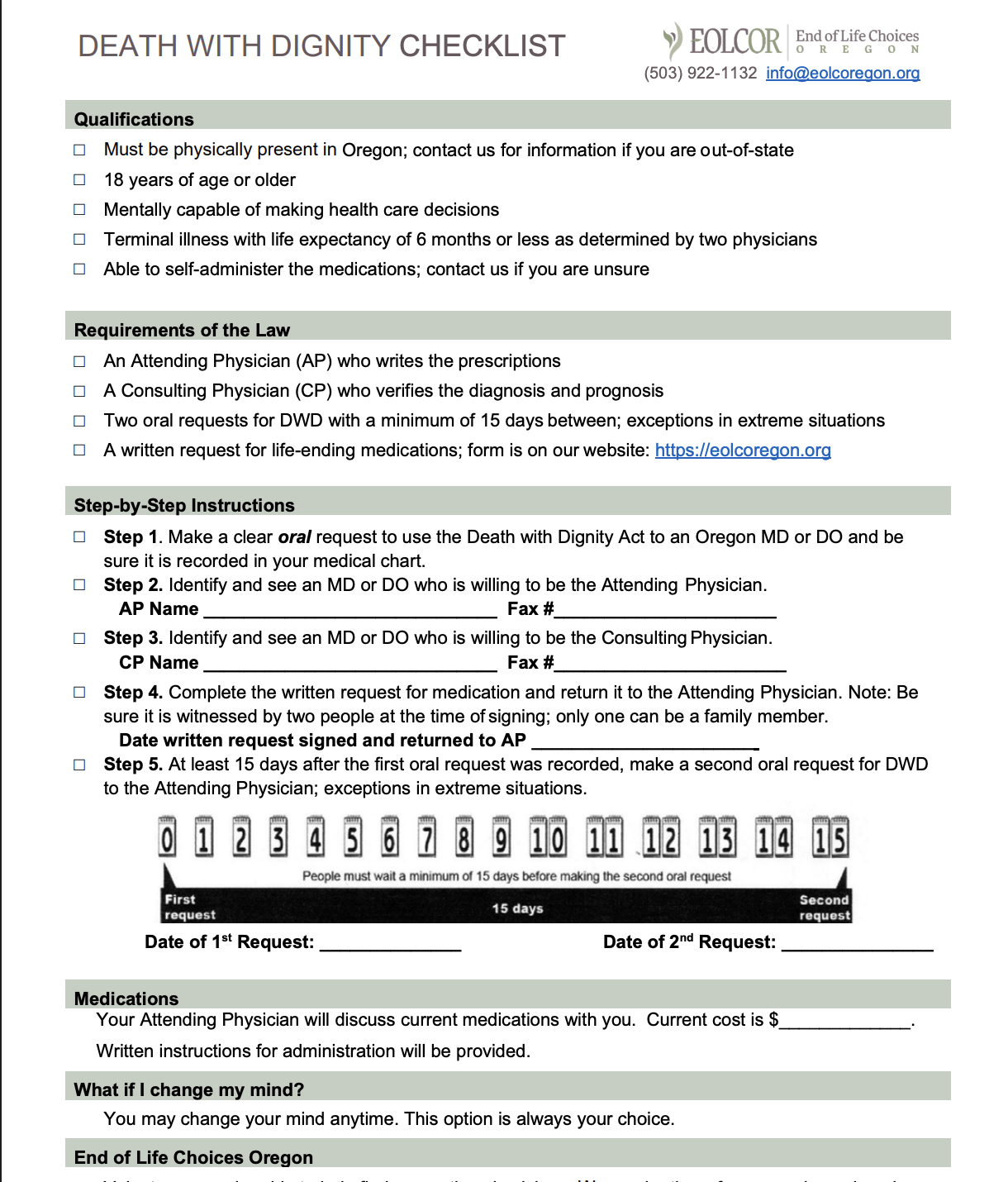
Death With Dignity Checklist
A comprehensive and clear PDF checklist of tasks and stages when using Oregon’s Death with Dignity Act.
-
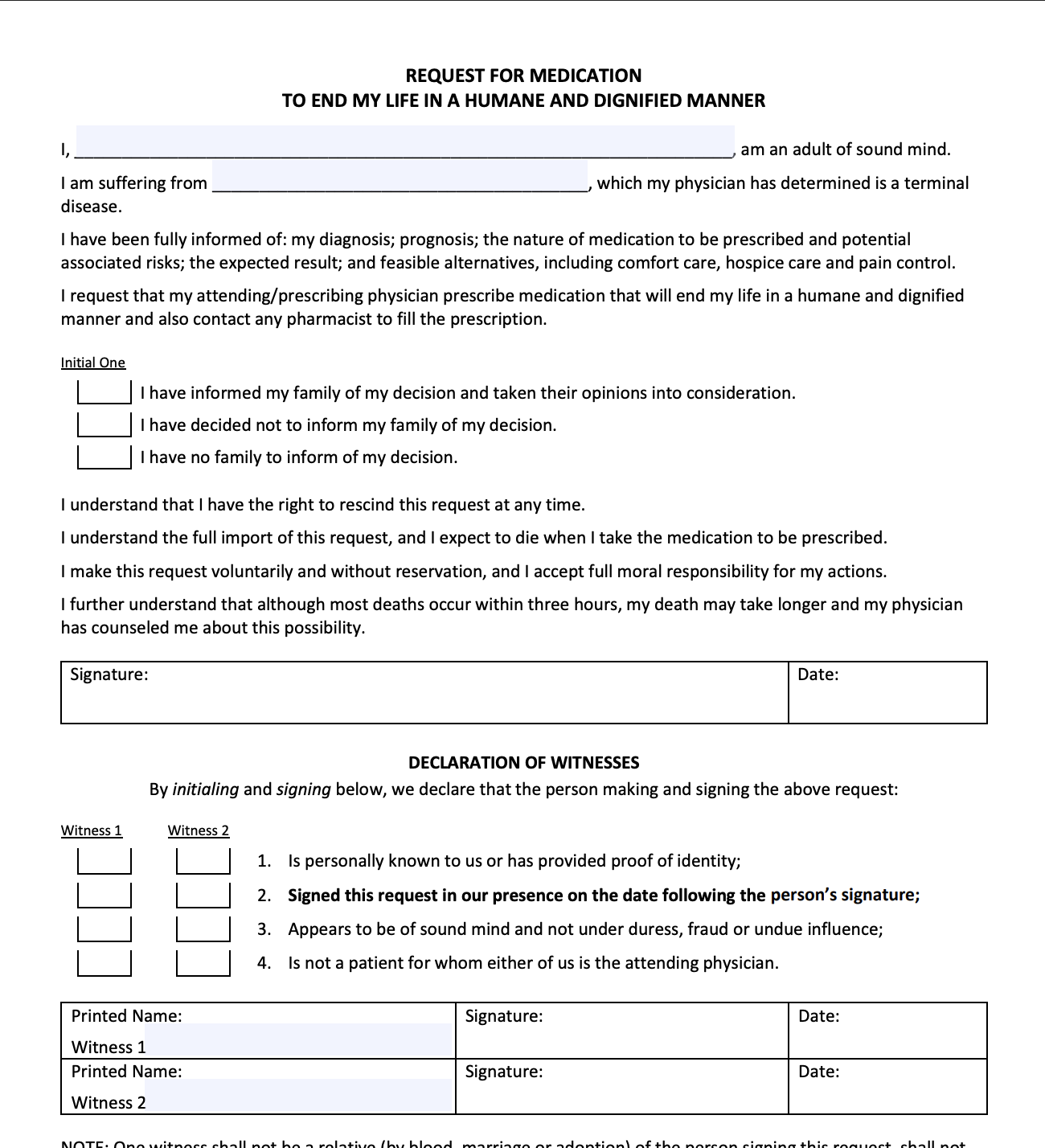
Request for Medication
Download the “Request for Medication to End My Life in a Humane and Dignified Manner” form required by Death With Dignity.
Frequently Asked Questions
-
The law has very specific requirements:
Two Oregon, licensed physicians must agree, to the best of their medical judgment, an individual is terminally ill, with 6 months or less to live.
The individual must be at least 18 years of age.
The individual must be able to make and communicate their own medical decisions.
The individual must be able to self-administer the life-ending medication, either by swallowing or self-administering through a feeding tube.
-
No. All requests must be expressed autonomously and directly to a participating physician at the time of qualifying and using the life-ending medication. Neither a legal document nor another person can make the required requests for you.
-
The life-ending medication varies and your Attending Physician will discuss the medication with you in detail as well as instructions for self-administration.
There is never an obligation to fill the prescription or take the medication.
-
No. A person must be able to make and communicate their own medical decisions at the time they are going through the Death with Dignity Act qualifying process, and at the time they decide to use the medication.
-
Life insurance benefits are not affected by using the Death with Dignity Act. The death certificates indicate the manner of death as “natural” and the cause of death as the individual’s underlying illness
-
It will say that the person died from their underlying illness. Life insurance is still in effect.
-
EOLCOR provides experienced volunteers to provide details about the law and the qualifying process. They are available to answer questions, guide and compassionately support you and your loved ones while qualifying. They can also help find qualifying physicians and be there to mix the life-ending medication on your planned death day.

Our Volunteers are Here to Help
EOLCOR has a state-wide network of trained volunteers who can provide expert guidance and support. Our volunteers can:
Answer your questions in person by phone or virtual visit and provide detailed information on the Death with Dignity Act.
Provide suggestions for conversations with your healthcare providers.
Provide required forms and helpful documentation.
Provide referrals, such as hospice and mortuaries.
Assist with finding participating physicians if your physicians can’t or aren’t willing to qualifying you.
Provide information and guidance to your healthcare providers about the Death with Dignity Act.
Provide in person support on the day of your planned death, to include mixing the life-ending medication.