

For Individuals & Loved Ones
Planned Death: Taking Life-Ending Medication
Once the 15-day qualification period is complete and all of the requirements for the Death with Dignity Act have been fulfilled, the Attending Physician can write the prescription for the life-ending medication. By law, the Death with Dignity Prescription must be sent or hand delivered directly to a participating pharmacy by the Attending Physician. There is no obligation to fill or take the end-of-life medication. The prescription can stay on file at the pharmacy until you are ready to use it or indefinitely.
The Death with Dignity Act allows individuals to choose who will attend their planned deaths and when they want them to occur. EOLCOR strongly advises clients to include EOLCOR’s experienced volunteers during their planned death to ensure a supportive and compassionate death.
Days Leading up to your Planned Death:
Notify your Attending Physician of your scheduled planned death date.
If you are an EOLCOR client, your volunteers will do this for you.
No laxatives 24 hours prior to ingestion of the life-ending medication.
An Implantable Cardioverter-Defibrillator is a medical device implanted to correct life-threatening, fast, abnormal heart rhythms by delivering an electric shock to reset the heart to a normal heartbeat. When you are near the end of life and choose to use the life-ending medication, the ICD must be deactivated, otherwise, the heart will be defibrillated during the dying process. The pacemaker function can be left on because it does not prolong life.
Day of Planned Death
You must demonstrate free choice to pursue Medical Aid In Dying and a clear understanding of the consequences of ingesting the life-ending medication.
Only clear liquids (no solids, dairy, fat or protein drinks) 4 hours before ingesting the life-ending medication.
Continue most routine medications.
Minimize alcohol and other recreational drugs.
If you’re on pain medications, take the last dose close to the time of ingesting the premedication, unless doing so causes sleep or affects your decisional capability to utilize MAID.
The premedication should be taken 1 hour before the life-ending medication or as prescribed by your Attending Physician.
Taking the Premedication
The premedication is taken 1 hour before the life-ending medication. It consists of medications to increase absorption in the digestive system and prevent nausea and vomiting.
Taking the Life-Ending Medication
The life-ending medication is a combination of 4-5 different medications that is distributed in a powdered dosage form.
The powder is diluted with 2-3 oz of a clear, nonfat liquid of your choice.
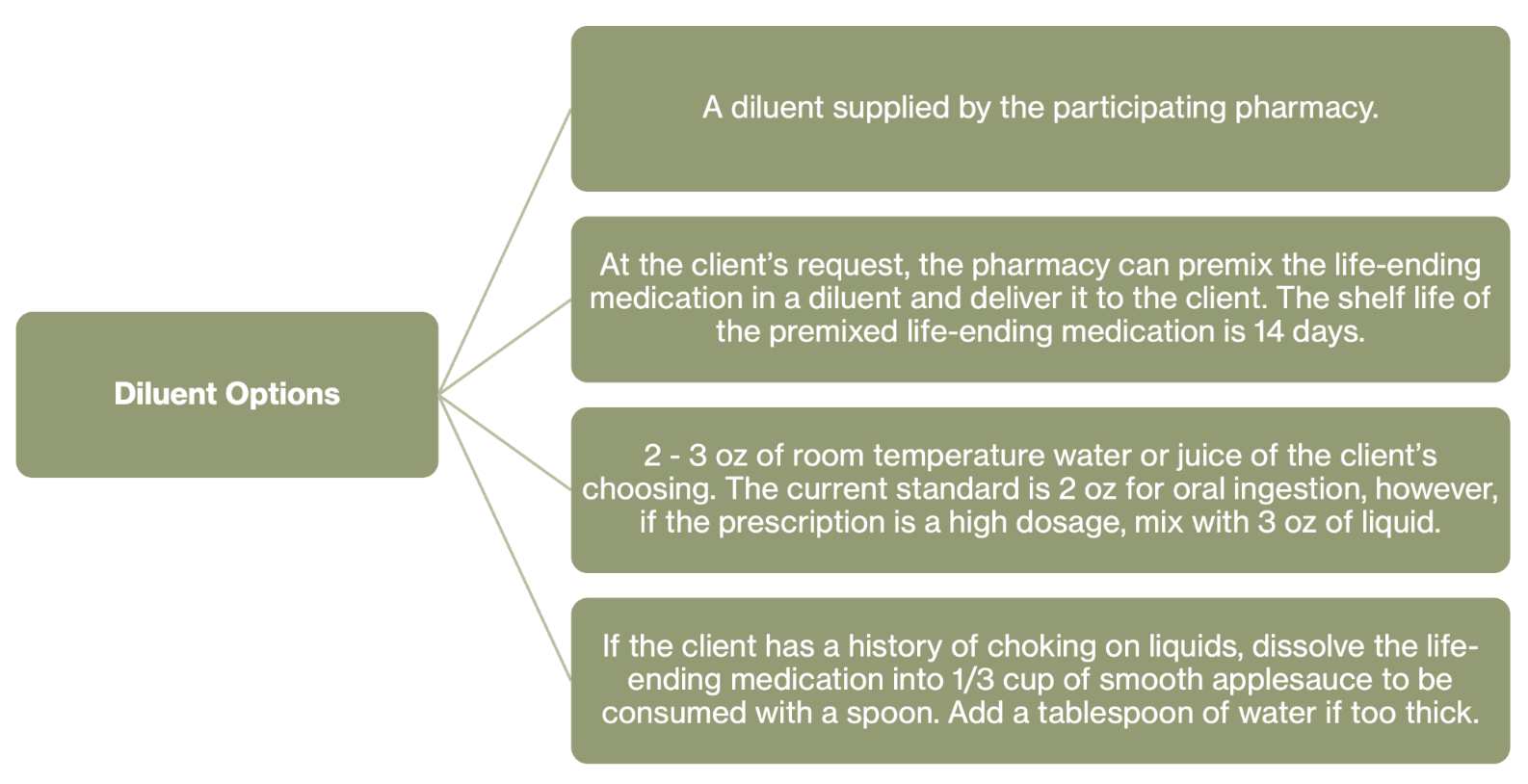
The life-ending medication must be self-administered.
If oral ingestion is not possible, this does not necessarily disqualify you for the Death with Dignity Act. Please discuss any challenges with your Attending Physician, who may be able to come up with an alternative plan for self-administering the life-ending medication.
FOR PEG TUBE ADMINISTRATION:
Use the instructions for Peg or Feeding Tube Administration for Aid-in-Dying from the Academy of Aid-in-Dying
Mix the life-ending medication in the medication bottle and shake vigorously for 2-5 minutes immediately prior to ingestion (the preferred method) or mix in a small cup of your choosing.
If you are too weak to hold the glass/cup, someone else can hold it for you and a straw can be used for ingestion.
For ingestion to qualify as self-administration you must have the ability to start and stop the intake of the life-ending medication.
If you want to drink the life-ending medication through a straw, use one with a large diameter. Position the straw towards the back of the mouth to bypass taste buds and reduce bitterness.
Before and/or after ingesting the life-ending medication, a taste of honey, sorbet, popsicle or a drink of a room temperature, uncarbonated, nonfat beverage may help minimize the bitter taste.
Sit in an upright position for ingestion, so gravity helps keep the life-ending medication down.
This can be accomplished by sitting on the side of the bed, raising the head of the bed, using pillows for support, or raising the back of a recliner.
As you fall asleep, you can move into a comfortable position, with your upper body somewhat elevated.
If you use oxygen, it can be discontinued once you are in a deep sleep.
Death occurs when both respiration and heartbeat can no longer be detected.
Time to death is variable, a volunteer, family member or caregiver should plan to stay with until death occurs.
Oregon law allows anyone to pronounce death. EOLCOR volunteers are trained to pronounce death and can do so if asked.
Direction for Disposal
To keep DDMAPh residue out of the public water system, use a paper towel to wipe any remaining medication out of the glass/cup and throw it in the trash. If the client has ingested the medication directly from the prescription bottle, tighten the cap on the bottle and dispose of it in the trash. If there is spillage, or some of the medication is expelled, remove the soiled materials and put them in a plastic bag that can be sealed and put in the garbage. Please do NOT wash these materials! It’s important to avoid adding them to the water ways.
If you fill the life-ending prescription, but do not take the life-ending medication, remove personal health information from the bottle and mix the medications in a zip lock bag with two (2) cups of coffee grounds or kitty litter. Then place it in the trash.
Can I wake up?
Awakening is possible, but is an extremely rare occurrence, occurring in less than 1% of individuals.
EOLCOR Volunteer Services for Planned Deaths
Two volunteers will attend your planned death.
If you do not want your volunteers to attend your planned death, one volunteer will stay available by phone for support if needed.
Volunteers cannot attend planned deaths if you live or stay in facilities that specifically does not allow Medical Aid In Dying. Volunteers can work with you to consider other accommodations for your planned deaths.
Details surrounding planned deaths are discussed and arranged with your volunteers before your planned death day along, this includes mortuary arrangements and hospice involvement.
Your planned death day can be changed or canceled at any time.
Your volunteer can prepare the life-ending medication if requested.
Your volunteer can call time of death if requested.

After the Death
Most planned death attendees prefer the mortuary to remove the body soon after death. If attendees prefer to keep the body longer than 24 hours, they should contact the mortuary regarding measures needed to conform with Oregon law.
If you are enrolled in hospice, the hospice Medical Director will provide your death certificate. If you're not enrolled in hospice, arrangements need to be made to inform the mortuary when the death has occurred and who will sign the death certificate (Attending, Consulting, or Primary Care Physician). If you are Receiving Hospices Services : Attendees or volunteers call hospice to inform them the planned death occurred. Give hospice the name and contact details for the mortuary when calling. Hospice staff will then call the mortuary to report the expected death.
If you are not Receiving Hospice services: Prior to the planned death, the mortuary must be informed of the designated day and time of the planned death and be provided with the phone number of the Attending/Prescribing Physician. The mortuary must confirm with the Attending/Prescribing Physician that they submitted the life-ending prescription in your name before the mortuary will pick up your body.
Death Certificates & Life Insurance.
The Death with Dignity Act, requires death certificates to indicate the manner of death as “natural” and the cause of death as the individual’s underlying illness (acute leukemia, COPD, chronic congestive heart failure, etc).
Life insurance benefits are NOT affected by using Oregon’s Death with Dignity Act.